The Southern Basin Soil and Water Environment Ecological Restoration Team at Guangxi University (GXU) has made new progress in the environmental behavior of microplastics. The related findings, titled “Mechanisms of Long-Term Nanoplastic Release in Soil and Their Interaction with Soil Colloids,” were published in the international environmental journal Environmental Science & Technology. Jinyu Li, a Master’s student at the School of Resources, Environment and Materials, is the first author, and Yan Liang, Associate Professor at the same college, is the corresponding author. GXU is listed as both the primary and corresponding institution for the paper.
To address the challenges of accurately separating, quantifying, and elucidating long-term release mechanisms of nanoscale plastics in natural soils, the team employed palladium-labeled nanoplastics combined with soil column experiments, ICP-MS, size-fractionation, asymmetric flow field-flow fractionation, and interfacial energetics calculations. This approach enabled systematic investigation of nanosplastic retention and release in natural soils and their interactions with soil colloids, improving quantitative accuracy in complex soil systems and enabling quantification of long-term release processes.
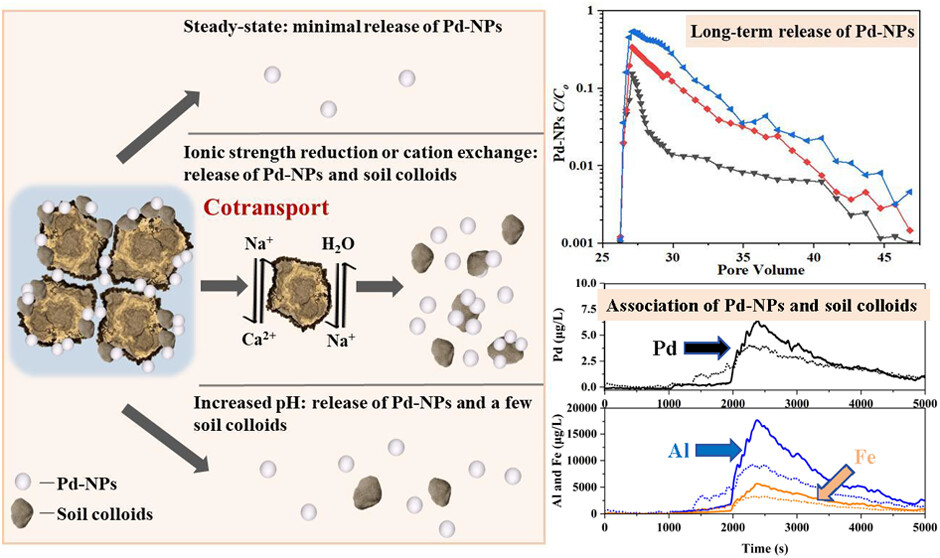
Long-term release of nanosized plastics in soils and co-transport with soil colloids
The study found that nanoscale plastics tend to be retained by soils under stable conditions. When ionic strength decreases, pH increases, or Ca2+-Na+ exchange occurs, some particles are gradually released. Under low ionic strength and cation-exchange conditions, the released nanos plastics primarily bind to and co-migrate with soil colloids; under higher pH, independent migration becomes dominant. The results further reveal a dual role of soil colloids: under stable conditions they can act as retention carriers for nanos plastics, while environmental changes can convert them into mobile carriers that promote long-term release. This work deepens the understanding of migration and transformation mechanisms of nanos plastics in natural soils and provides a scientific basis for assessing groundwater contamination risk and long-term environmental effects.
This research was funded by the National Natural Science Foundation of China, the Guangxi Natural Science Foundation, and the Guangxi Key R&D Program, among others.

 Address: No.100,East Daxue Road,Xixiangtang District,Nanning, Guangxi,China
 Postal Code: 530004
 Tel: 86-771-3238863
 Email: gjc@gxu.edu.cn