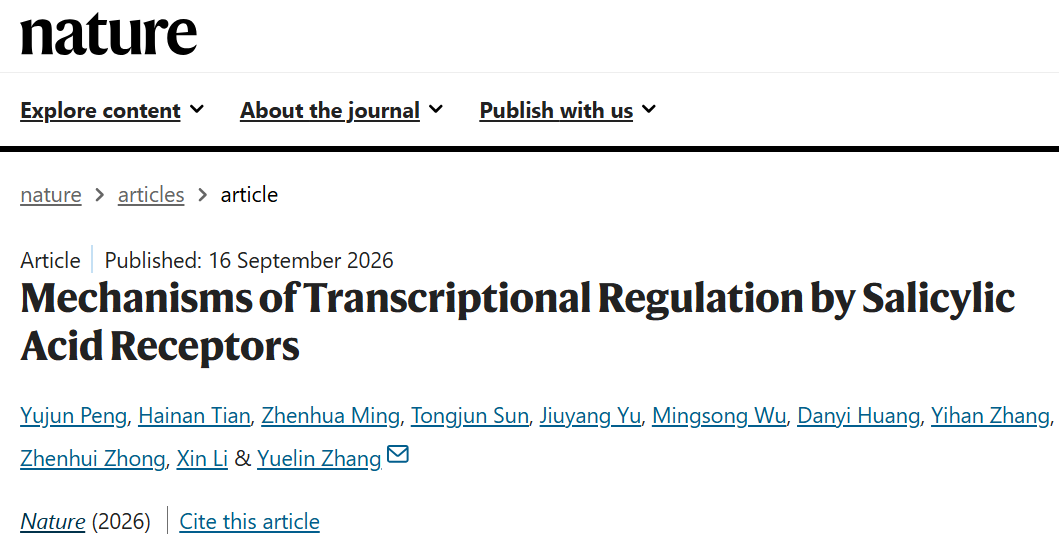
Recently, the research team led by Professor Ming Zhenhua of the School of Life Sciences and Technology at GXU, in collaboration with Sichuan University, the Shenzhen Institute of Agricultural Genomics of the Chinese Academy of Agricultural Sciences, the University of British Columbia in Canada, and other institutions, published a research paper entitled “Mechanisms of Transcriptional Regulation by Salicylic Acid Receptors” in Nature. Professor Ming Zhenhua is the paper’s second author, and GXU is the third affiliated institution. In this study, the GXU team was primarily responsible for elucidating the structural mechanisms underlying the interaction between salicylic acid-induced receptors and transcriptional regulatory proteins.
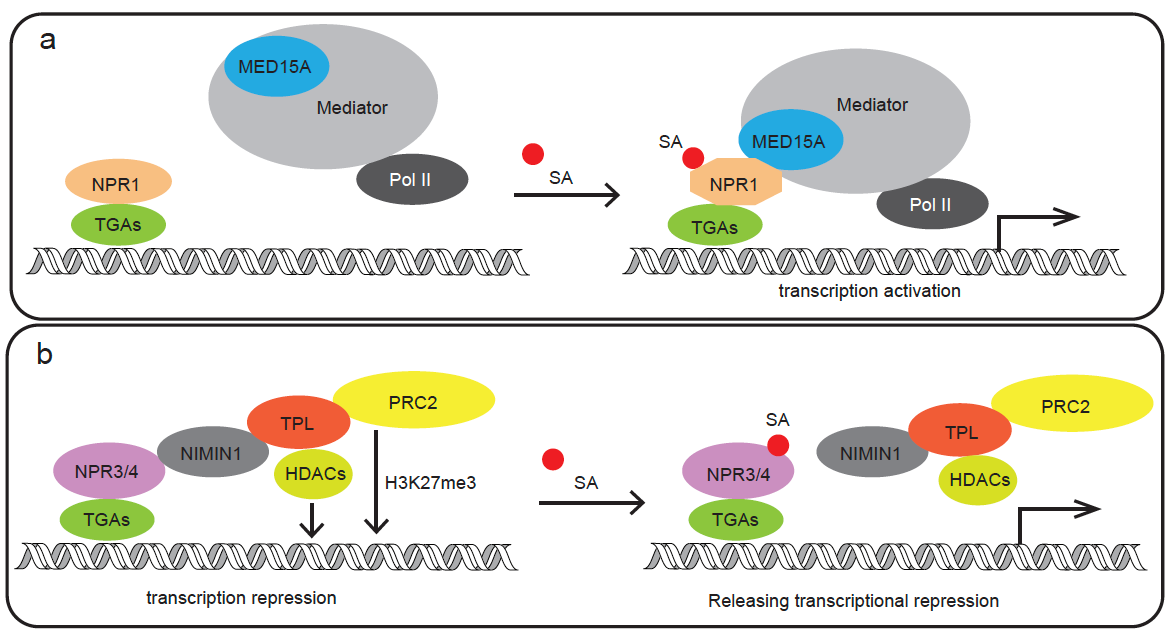
When plants are infected by pathogens, they synthesize large amounts of salicylic acid (SA) to activate the expression of disease-resistance genes and establish resistance to pathogens. SA can bind to two types of receptors, NPR1 and NPR3/4. NPR1 positively regulates the transcription of disease-resistance genes, whereas NPR3/4 negatively regulates their transcription. However, how SA differentially regulates these two types of receptors to achieve precise transcriptional control of disease-resistance genes had remained unclear.
The study made two key discoveries. First, SA binding induces an interaction between NPR1 and the KIX domain of MED15A, a component of the Mediator complex, thereby effectively recruiting RNA polymerase II and activating the transcription of disease-resistance genes. Disrupting the NPR1-MED15A interaction interface prevents SA from properly activating the expression of these genes, ultimately weakening plant disease resistance. Second, the study found that the NIMIN1 protein mediates the formation of a transcriptional repression complex between NPR3/4 and TPL, thereby silencing disease-resistance genes. SA binding inhibits the interaction between NPR3/4 and NIMIN1, relieving the repression of disease-resistance gene transcription by NPR3/4. The study systematically elucidates how SA regulates the expression of plant disease-resistance genes through its interaction with NPR receptors, providing an important theoretical basis for improving SA signaling pathways and enhancing crop disease resistance.
This research represents another important collaborative advance by the Structural Biology Team of GXU’s School of Life Sciences and Technology in plant signaling research, following the team’s related publication in Nature Plants in August 2026, for which Professor Ming Zhenhua was a co-corresponding author and GXU a co-corresponding institution.

 Address: No.100,East Daxue Road,Xixiangtang District,Nanning, Guangxi,China
 Postal Code: 530004
 Tel: 86-771-3238863
 Email: gjc@gxu.edu.cn